

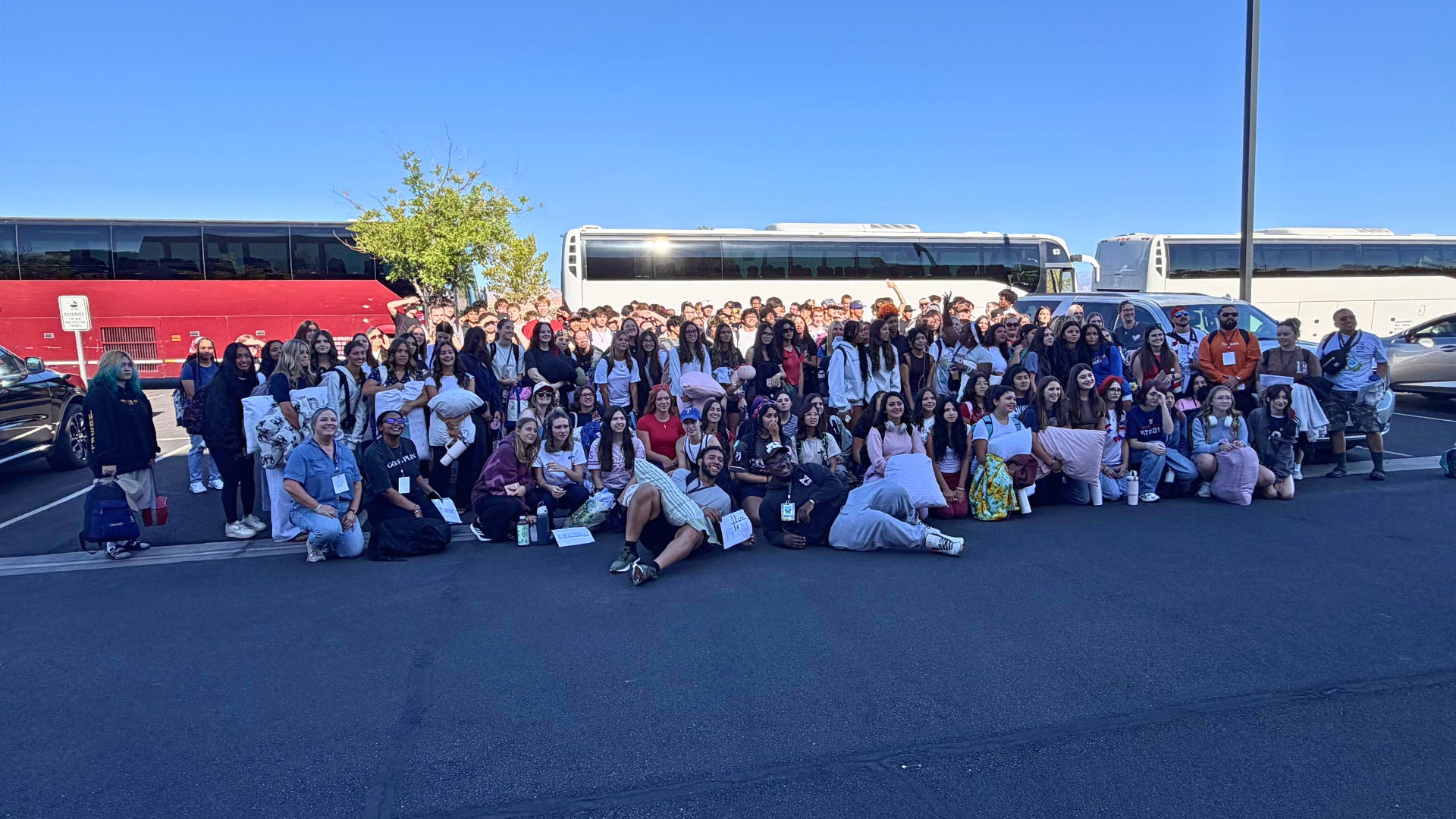
This week, we sent our daughter off to church camp for the last time.
She started going after third grade.
Now she’s a high school graduate, heading to college in the fall.
For nine years, she’s packed a suitcase, her Bible and a backpack full of snacks, boarded a bus and headed off for a week of fun.
As I watched her leave, I realized something.
Church camp has become a family tradition.
Her older brother went every summer.
My husband and I both attended camp as teenagers.
Even Grandma has camp stories from decades ago.
And before camp, there was Vacation Bible School.
Every generation in our family has been shaped by adults who believed the next generation was worth investing in.
I’m grateful for that.
I really am.
Because church camp is about more than fun.
It’s about refocusing, reconnecting, and recentering our relationship with Jesus.
Adults have retreats.
Teens have camp.
And camp matters.
It’s where lifelong friendships begin.
Where students finally ask the questions they’ve been carrying.
Where worship feels personal instead of performative.
Where a teenager hears, some for the first time, that God knows them, loves them, and has a purpose for their life.
Every summer we celebrate stories like these.
Thousands attending camp.
Hundreds baptized.
Students saying yes to Jesus.
And we should celebrate.
Every. Single. One.
But as I watched the buses pull away this week, one question kept lingering in my mind: What happens after?
After the emotional week.
After the late-night conversations.
After the campfire commitments.
After the trust has been built and the walls lowered.
After students experience what authentic Christian community can feel like.
Because church camp can ignite faith.
The other fifty-one weeks determine whether that flame keeps burning.
Too often, students come home to a very different environment.
Phones that never stop buzzing.
Schools where following Jesus can feel lonely.
Anxiety, comparison, temptation, and the constant pressure to fit in.
We’re all being discipled by something.
And for our teens, the world is more than willing to shape their identity and define their worth.
One week of church camp can’t compete with fifty-one weeks of formation happening everywhere else.
And it was never supposed to.
As I continued to ponder, I began to question if churches are investing in the next generation as much as they proclaim they are?
Celebrating camp highlights and what God did is important.
We should celebrate.
But a few words of encouragement from the stage on a Sunday isn’t enough.
Practically, how are we investing in the spiritual lives of not only these teens, but the future church?
Because if you ask any children’s or student ministry leader, they will tell you about some of their challenges:
Leaders trying to shepherd too many kids with too few spiritually mature adults.
Planning evangelism events on a pizza and water budget.
Unclear stance and/or unsupported by leadership on controversial topics facing teens.
We say we believe the next generation is the future of the church.
And we do believe it.
BUT…
Our budgets don’t always tell the same story.
Our staffing doesn’t always tell the same story.
Our priorities don’t always tell the same story.
If the production budget is double the next generation budget, what message are we unintentionally communicating?
Don’t get me wrong.
Every ministry matters, including production.
But if we truly believe today’s children and teenagers are not just the future church, but part of the church right now, then our investment should reflect that conviction.
Not just during one exciting week in the summer.
All year long.
But it’s not the church’s sole responsibility to disciple our kids
Discipleship has never been something we’re called to outsource.
It something that starts with us as parents.
God told His people:
“These commandments that I give you today are to be on your hearts. Impress them on your children. Talk about them when you sit at home and when you walk ...about them when you sit at home and when you walk along the road, when you lie down and when you get up.” (Deuteronomy 6:6–7)
Long before there were youth pastors, student ministries, and church camps, God entrusted parents with the privilege and responsibility of discipling their children.
Not by having all the answers.
But by faithfully pointing them to Him in the ordinary moments of everyday life.
At the dinner table.
On the drive to school.
Before bedtime.
During difficult conversations.
When life is joyful.
And when life falls apart.
But here’s the challenge: We can’t lead our children somewhere we’re unwilling to go ourselves.
If we want our kids to know God’s Word, we have to spend time in it ourselves.
If we want them to have an authentic prayer life, they need to see us pray.
If we want them to value Christian community, they need to watch us pursue it.
If we want them to keep growing spiritually after camp, we have to keep growing spiritually after Sunday.
Discipleship isn’t something we outsource to a pastor, a small group leader, or a week at camp. It’s something we model everyday through personal Bible reading, prayer, honest conversations, Christian community, and a willingness to keep learning ourselves.
After all, “As iron sharpens iron, so one person sharpens another.” (Proverbs 27:17)
When parents, churches, small group leaders, volunteers, and mentors all commit to that kind of lifelong discipleship, something beautiful happens.
The sparks that ignite at VBS and camp don’t have to fizzle out when summer ends.
Together, we can continue tending the fire.
Because the goal was never one unforgettable week.
The goal has always been a lifetime of following Jesus.
Questions to Consider
If a student watched my faith for one ordinary week, what would they learn about following Jesus?
Are we investing more energy into creating memorable moments or cultivating lifelong disciples?
What is one practical way I can help keep the fire burning in the life of a child or teenager after camp ends?
Keep Reading:
What the Church Can Learn from Off Campus
Who Are You Without Labels?
Is My Allegiance Divided?

Hi! I’m Torrie. Thanks for stopping by.
If this article encouraged you, provided language for what you’re feeling,
or challenged you, I’d love to hear your story in a comment below.
There are SO MANY sensible, thoughtful, knowledgeable, wise points in this article. How do we pour into students after a week at summer camp or vacation Bible school? It's definitely an important challenge to plan and prioritize.