

This is the third essay in Perverse, a series about the good and holy things we’ve bent into something that no longer reflects God. If you’re finding it later, you can read them in any order.
I’m loyal. To a fault.
Anyone who knows me knows it’s true. I hang on too long. I fight too hard. And I struggle to walk away, even when I know it’s for the best.
For a long time, I thought that was simply a virtue. Loyal sounds like faithful, steadfast, dependable. But I’ve started to wonder whether some of my loyalty was quietly keeping score.
When loyalty to people gets bent
Loyalty is good. In fact, God demands it. The very first commandment is a call to loyalty: “You shall have no other gods before me“ (Exodus 20:3).
But loyalty bends easily. Staying is easier when leaving means someone might be disappointed. Staying is easier when my sense of worth is wrapped up in being needed. Staying is easier when I believe it’s my job to fix what’s broken. Staying is easier when I convenience myself that the next opportunity is just around the corner. And staying is easier when I feel like I owe someone.
So we stay in relationships, jobs, ministries, and churches long after God has started releasing us. We convince ourselves, or we’re convinced by others, that what we’re doing is so important we have to stay. We take on the role of fixer. If I stay a little longer, I can heal the hurt and turn this thing around.
But not everything is ours to fix. That was never our job.
Our job is to be obedient.
So how do we know whether to stay or go?
1. Prayer that’s honest enough to ask God what we’re afraid to hear.
2. Wise counsel, because “plans fail for lack of counsel, but with many advisers they succeed“ (Proverbs 15:22).
3. Discernment, the practiced muscle of recognizing God’s voice over the voices of approval, obligation, and fear.
But the truth is, you can know and do all of these things and still choose loyalty over obedience.
Recently, a friend reminded me that loyalty and obedience are like when God was in the cloud (Numbers 9).
Sometimes the cloud [God] moves and our loyalty causes us to stand still, afraid to let go of what was and move forward to what’s next.
And the church doesn’t always help. We celebrate leaders who stay for decades, and we should give honor where honor is due (Romans 13:7). But somewhere along the way, we started measuring obedience by longevity. Moving on doesn’t equal disloyalty, just as a long tenure doesn’t measure obedience.
Paul names the root of it plainly: “Am I now trying to win the approval of human beings, or of God? Or am I still trying to please people? If I were still trying to please people, I would not be a servant of Christ“ (Galatians 1:10).
Loyalty to people, places and causes can distract us.
But there’s another loyalty that can become distorted and perverse...and it’s much harder to admit.
When loyalty to God keeps score
About twenty years ago, I found out I was pregnant. We weren’t planning on more kids, but once we knew, we were excited.
At our twelve-week appointment, we learned there was no heartbeat.
I prayed with a desperation I’d never prayed before. I saw three more doctors. The fact remained.
I was angry. I hadn’t even wanted more kids and once we had the opportunity, it felt so cruel to have it unexpectedly yanked away. I came home from the final appointment and threw my Bible in the trash. My husband retrieved it from under the coffee grounds while I sobbed in our room.
I had been in church my whole life. I accepted Jesus as my Savior when I was five. I served. I led. I devoted my life to God. I was loyal to Him. But when I needed Him most, it felt like the loyalty only went one way.
I don’t think I’m the only one who has felt that. We read and study His Word. We start ministries. We attend every event. We serve others and check all the so-called boxes. And somewhere in all that faithfulness, a quiet expectation creeps in: I’ve been loyal to You, so You owe me and our loyalty to God stops being worship and becomes a contract.
Elijah under the tree
Elijah knew that feeling well.
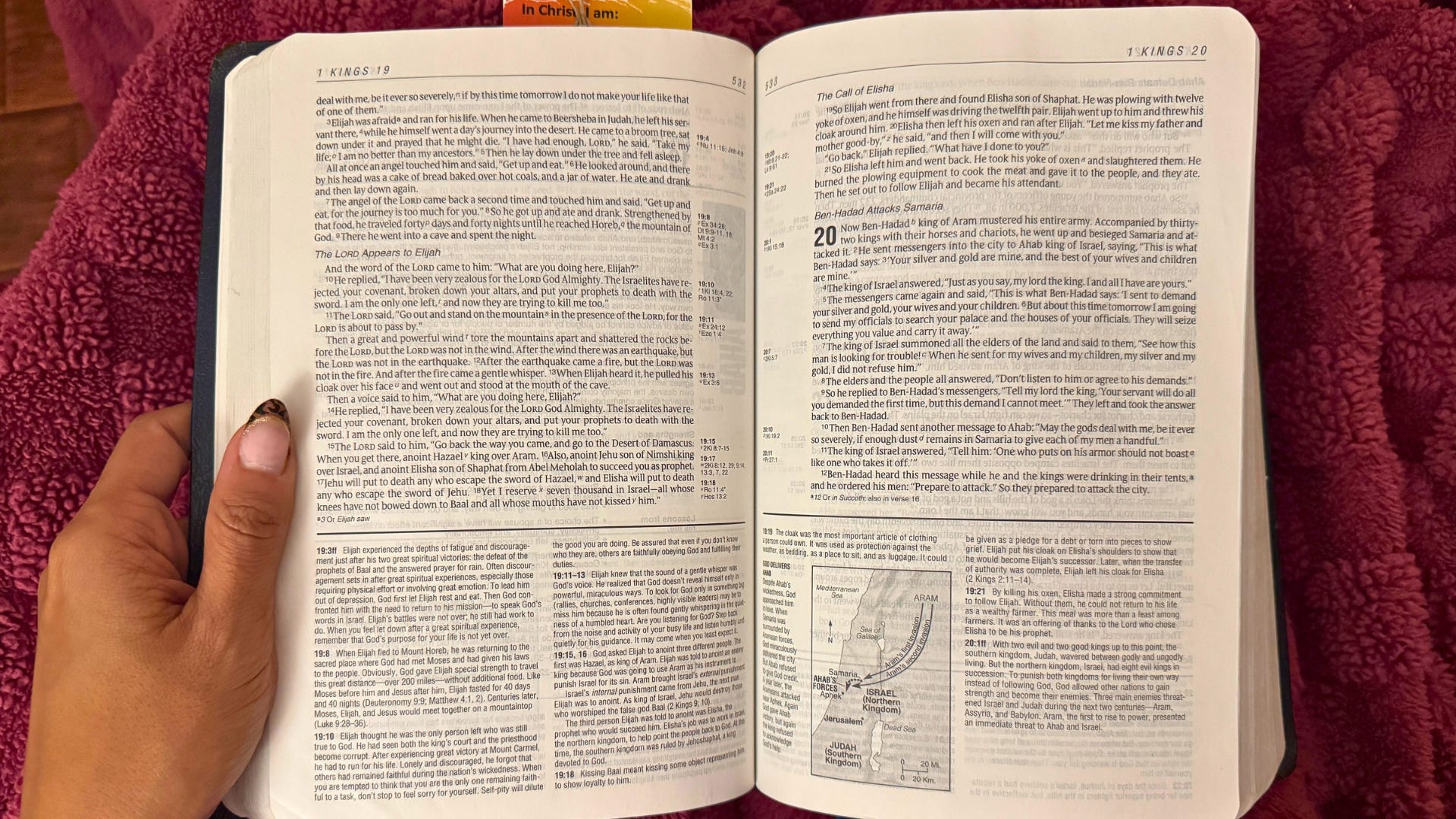
In 1 Kings 17 and 18, God proved Himself again and again. He fed Elijah by ravens. He kept a widow’s flour and oil from running out. He sent fire from heaven on Mount Carmel in front of hundreds of prophets of Baal.
Then one threat from Queen Jezebel, and Elijah ran. He sat under a tree and asked God to take his life (1 Kings 19:4). Later, hiding in a cave, he laid out his résumé: “I have been very zealous for the LORD God Almighty. The Israelites have rejected your covenant, torn down your altars, and put your prophets to death with the sword. I am the only one left, and now they are trying to kill me too“ (1 Kings 19:10).
In other words: Look at everything I’ve done for You. And look where it got me.
It sounds a lot like my anger that year.
What strikes me is how God responded. He didn’t scold Elijah or provide an explanation. Before Elijah ever reached the cave, God sent an angel to feed him and let him rest, “for the journey is too much for you“ (1 Kings 19:7). Then God came to him, not in the wind, the earthquake, or the fire, but in “a gentle whisper“ (1 Kings 19:12). He gave Elijah a new assignment and a successor named Elisha to walk alongside him (1 Kings 19:15–16). And He reminded Elijah that he wasn’t alone. Seven thousand others had stayed faithful (1 Kings 19:18).
God’s loyalty to Elijah didn’t start in that cave. It had been there all along.
And the same is true for us, but too often we, like Elijah, fail to see it.
But what did Jesus say?
Jesus told His disciples something that still stings a little: “So you also, when you have done everything you were told to do, should say, ‘We are unworthy servants; we have only done our duty’“ (Luke 17:10).
That isn’t Jesus being harsh. It’s Jesus being honest about who owes whom. Our obedience doesn’t put God in our debt, because He was loyal to us first. “God demonstrates his own love for us in this: While we were still sinners, Christ died for us“ (Romans 5:8).
Before we ever took a breath, before we read a single verse or served within a ministry, God had already shown His loyalty through His Son. And over and over, He has proven His faithfulness, His sovereignty, and His love.
Sovereign and still loyal
It took years and a lot of therapy for me to reconcile that season. Slowly, I came to understand that God didn’t owe me anything.
That doesn’t mean He wasn’t listening. We are invited to cry out to Him, and He does hear our prayers. But He is sovereign, and His sovereignty doesn’t always feel good or make sense.
I’ve learned to hold on to this truth: when God’s sovereignty doesn’t aline with my expectations, that doesn’t define His loyalty to me. Or to any of us.
Maybe that’s the thread that runs through both kinds of perverse loyalty. With people, we stay because we’re afraid of what we’ll lose if we leave. With God, we stay because we think He’ll owe us. Either way, we’ve turned loyalty into a ledger.
But God’s loyalty was never a transaction. It’s a gift. And ours is meant to be a response, not a payment.
Next week, we’ll look at another good thing we’ve bent out of shape: purity. What happens when a holy invitation becomes a list of rules we were never meant to carry?
Sit With This
Where might you be staying out of obligation or a need to be needed, rather than obedience?
Is there a season when your loyalty to God felt one-sided? What did you expect Him to owe you?
How might it change your faith to see your loyalty as a response to His, not a payment for it?
Keep Reading
This is the third essay in Perverse, a series asking how we’ve taken good and holy things and turned them into something that no longer reflects God. Next week: Perverse Purity. Until then, here are a few more to sit with:
Perverse Perseverance: The first essay in the series, on when our refusal to quit becomes an idol.
Perverse Surrender: The second essay in the series, on what happens when the thing God gave us becomes the thing we won’t give back.
Not Every Hard Thing Is Bad: When something good still hurts.

Hi! I’m Torrie. Thanks for stopping by.
If this article encouraged you, provided language for what you’re feeling,
or challenged you, I’d love to hear your story in a comment below.