

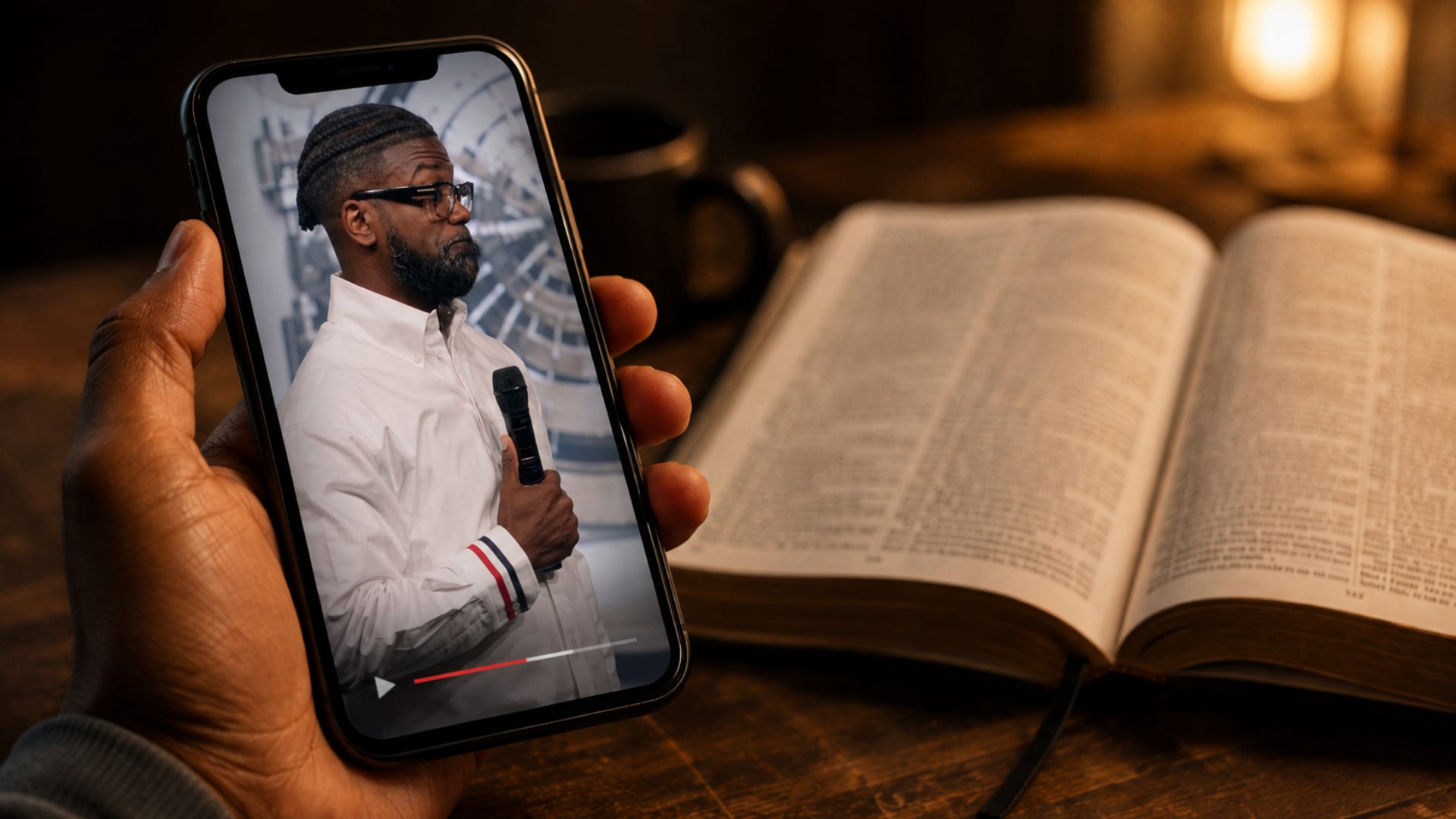
A couple of weeks ago, a sermon clip from Pastor Stephen Chandler showed up in my Threads feed.
He was talking about appearance and referenced a familiar verse:
“People look at the outward appearance, but the Lord looks at the heart.”
—1 Samuel 16:7
But the application caught my attention.
The point seemed to be that while God may look at our hearts, people look at our outward appearance. So if we want to lead or influence people, we need to consider how we look.
Almost immediately, I had questions.
That isn’t what 1 Samuel 16 is teaching. And the examples he used carried another layer that couldn’t be ignored.
Here were some of the concerns I—and others in the comments—had.
1. The verse is taken out of context
In 1 Samuel 16, God sends Samuel to Jesse’s house to anoint Israel’s next king.
Samuel sees Jesse’s oldest son, Eliab, and immediately thinks, Surely this is the one.
He looks like a king.
God corrects Samuel:
“Do not consider his appearance or his height, for I have rejected him. The Lord does not look at the things people look at.”
—1 Samuel 16:7
Then comes the familiar line:
“People look at the outward appearance, but the Lord looks at the heart.”
The point isn’t that people judge appearances, so we should accommodate their judgments. Samuel was doing exactly that—and God corrected him.
People evaluate what they can see. God sees deeper.
Using this passage to support adjusting ourselves because people judge appearances reverses its emphasis.
God wasn’t telling Samuel, People care about appearances, so make sure you look the part.
He was correcting Samuel for assuming the person who looked the part must be the right person.
2. He perpetuates negative stereotypes
The examples bothered me too.
Durags. Bonnets. Certain hairstyles. Certain clothes.
Those examples carry cultural assumptions.
When markers associated with Black culture become shorthand for people may not take you seriously, we have to ask whether we’re teaching wisdom or reinforcing stereotypes.
One commenter pointed out that the same logic could easily be applied to Chandler himself. His hairstyle could cause someone in another cultural environment to make assumptions about him.
Should he change it so those people will listen?
What about natural hair? Braids? Locs? An accent? Tattoos? A woman preaching?
At what point does “consider how people perceive you” become conform to whatever makes other people comfortable?
And whose version of “professional,” “respectable” or “appropriate” gets to set the standard?
Another commenter asked an even better question:
Are we more concerned with looking like Christians or living like Christ?
Scripture talks about outward evidence of inward transformation, but that evidence looks like fruit. (Galatians 5:22–23) Jesus said people would recognize His disciples by their love. (John 13:35)
Our lives should reflect what God is doing within us.
But that is very different from assuming Christian influence requires a particular aesthetic.
Jesus repeatedly chose people society overlooked: the Samaritan woman, lepers, tax collectors, women others condemned, fishermen.
Which makes me ask my favorite question:
But what did Jesus do?
Did Jesus teach people to become more socially acceptable so they could influence others?
Or did He challenge the assumptions people used to decide who was worthy of being heard?
I had serious concerns about the clip.
And then I realized something.
I had only watched a clip.
3. The clip can be problematic and incomplete
Both things can be true.
I can believe the Scripture was applied poorly, question the stereotypes in the examples and still acknowledge that I hadn’t heard the entire sermon.
Maybe Chandler offered more nuance elsewhere.
Maybe the full sermon would make my concerns worse.
I didn’t know.
And suddenly the question became bigger than one preacher:
How much can we responsibly conclude from a fragment of a full message?
Because this is increasingly how we encounter Christian teaching.
Sermons become clips. Books become quote cards. Bible studies become reels, TikToks and Threads posts.
Our theology can begin to take shape through fragments.
That matters because social media isn’t designed for nuance. It’s designed to keep us watching.
Outrage travels. Shock travels. Conflict travels.
A pastor carefully explaining the historical context of a passage probably won’t spread as quickly as one sentence that makes thousands of people say:
WAIT. WHAT?
Sometimes those clips expose genuinely harmful teaching, and they should be examined.
Teachers carry enormous responsibility for how they handle Scripture. James warns that teachers will be judged more strictly (James 3:1), and Paul tells Timothy to become someone “who correctly handles the word of truth.” (2 Timothy 2:15)
Those who teach Scripture have a responsibility to represent it faithfully. So do those who package and share that teaching online.
But those of us consuming it have a responsibility too.
Because Christian clickbait can misrepresent a sermon just as easily as a sermon can misrepresent Scripture.
4. Sermon clips aren’t discipleship
Thirty seconds can start deiscipleship.
It can’t replace it.
I create short-form Christian content too.
I don’t think sermon clips, reels or Threads posts are inherently bad.
They can introduce an idea, challenge an assumption or send us back to Scripture.
Sometimes thirty seconds makes someone want to learn more. But that should be the beginning.
Acts gives us a model for what comes next.
When Paul and Silas taught in Berea, the people eagerly received their message—but then they “examined the Scriptures every day to see if what Paul said was true.” (Acts 17:11)
They listened.
Then they checked.
They were receptive and discerning.
Maybe that’s the posture we need in an era of thirty-second theology.
When a clip makes us angry, inspired or certain someone is wrong, maybe our first question shouldn’t be:
Do I agree with this?
Maybe it should be:
What am I missing?
What does the passage actually say?
What context surrounds the clip?
Does the application align with the larger witness of Scripture?
And am I trying to understand—or simply confirming what I already believe?
Because we can all do this.
We give context generously to teachers we love:
You need to hear the whole sermon.
Then share fifteen seconds from someone we distrust as proof that they’re dangerous.
That isn’t discernment.
That’s confirmation bias with a Bible verse attached.
Paul warned the church about remaining spiritually immature, “tossed back and forth by the waves, and blown here and there by every wind of teaching.” (Ephesians 4:14)
That verse sounds different when theology flies across our feeds at algorithmic speed.
Another pastor. Another controversy. Another interpretation. Another confident opinion.
The algorithm can introduce us to ideas. It cannot do the work of discipleship for us.
Paul tells the Thessalonians:
“Test everything; hold fast what is good.”
(1 Thessalonians 5:21)
Everything.
The teacher you disagree with. The teacher you love. The clip that makes you furious. And the one that confirms everything you already believe.
I still think the Stephen Chandler clip deserves critique. Hearing the entire sermon may not erase my concerns about how the Scripture was used or the stereotypes the examples reinforced.
But the longer I sat with it, the more I realized discernment asks something harder of me than simply reacting correctly.
It asks me to keep looking.
To return to Scripture.
To seek fuller context.
To test what I’m hearing.
And to be willing to discover that I was right…or that I missed something.
Don’t confuse exposure with formation.
Don’t confuse a clip with a conclusion.
Let the clip make you curious. Let it send you back to the sermon, back to Scripture, back into community and, ultimately, back to Jesus.
Because discipleship was never meant to happen at scroll speed.
Look Again
Before moving on, take a minute to notice how you’re being formed by the Christian content you consume. There aren’t perfect answers here—just an invitation to become more curious about what you hear, share, and allow to shape you.
Where do I tend to form conclusions too quickly—from a clip, quote, headline, or comment—without seeking fuller context?
Whose teaching am I most likely to accept without question, and whose am I most likely to dismiss without listening carefully?
What would it look like for me to practice deeper discipleship this week by returning to Scripture, asking better questions, and resisting the urge to let the algorithm do my thinking for me?
Keep Reading:
If this article sparked your interest, you may also enjoy these:
Have We Made the Church into Target?
How convenience has quietly shaped the church, and how we can refocus on making disciples.
Snakes on a Plane
Jesus said to spread the Gospel. But did He mean like this?

Hi! I’m Torrie. Thanks for stopping by.
If this article encouraged you, provided language for what you’re feeling,
or challenged you, I’d love to hear your story in a comment below.